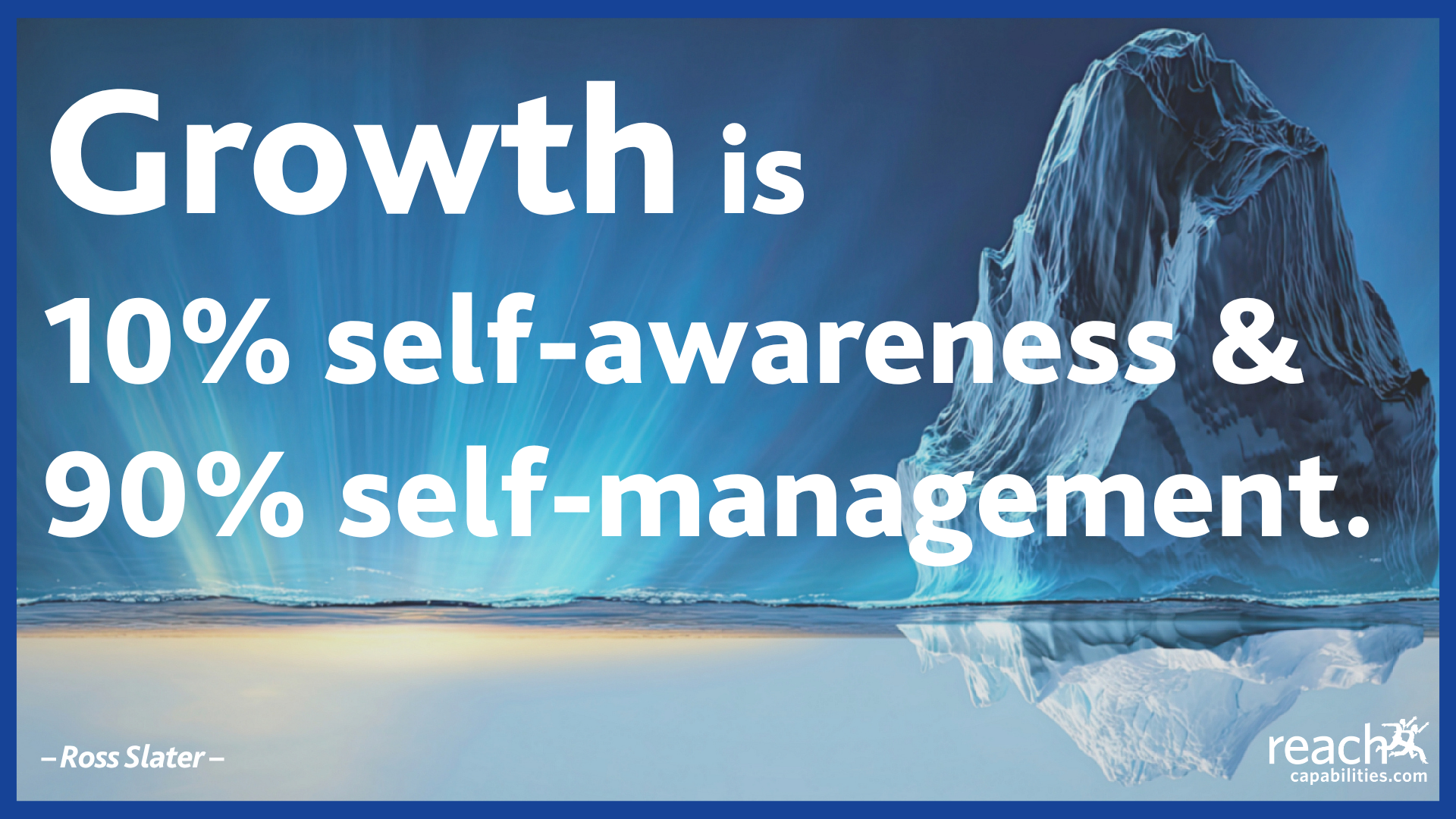
Although we’ve always seen and explained the connection between self-awareness and self-management, over the past few months, we’ve realized there is a disproportionate amount of effort between them in order to change and grow. Even as we encourage others to better understand their talents, strengths, weaknesses, and capabilities—that is only part of the battle. Everyone still needs to figure out how to leverage their learning. And it’s not a 50/50 split of effort. It’s more 10% self-awareness and 90% self-management.
Most of us already know a lot more about ourselves than we actually put into practice. We know we should listen more, control our reactions, exercise regularly, spend less time on our phones, or have that difficult conversation we’ve been avoiding. The challenge isn’t usually a lack of awareness. It’s managing ourselves to translate that awareness into appropriate action.
Self-awareness is like having a map. It tells us where we are, where we’d like to go, and perhaps even the obstacles we’ll face along the way. But a map is just a blueprint. Action still needs to be taken so something gets built. That’s the role of self-management: the ability to regulate our emotions, manage our habits, stay disciplined, and choose responses that align with our values rather than our impulses.
Knowledge is said to be power, but actual power comes from effectively applying what we know. Knowing patience is a short-coming, doesn’t make us more patient. Recognizing we avoid difficult conversations doesn’t make having them any easier. Growth occurs when we intentionally manage ourself differently, one decision at a time.
This is where all development models converge. Emotional intelligence, personality preferences, resilience, conative abilities, etc., they all increase our understanding of ourselves. But their real value lies in what we do with that understanding. Insight without self-management won’t changes outcomes. Appropriately managing ourselves by taking consistent and repeated actions, changes everything.
Self-management also shapes the way we work with others. When we recognize and appreciate our own natural capabilities, we’re less likely to assume everyone else should think or behave the same way. Or as one of our clients once said, “I thought everyone was just like me, only not as good.” Instead of automatically reacting, we become more intentional. We ask better questions, listen more carefully, and adapt our approach to the people around us. In doing so, we strengthen relationships and create environments where different perspectives become an advantage rather than a frustration. The true power of diversity is leveraging it for better results.
The best leaders don’t necessarily have all the best qualities, but they usually are the ones who manage themselves well. They have the same thoughts and emotions as their team members, but they generally only express them appropriately. They remain calm under pressure, stay true to their values when circumstances become difficult, and choose behaviours that build trust, even when those choices aren’t the easiest ones.
Self-awareness is not the end goal, it’s the starting point! Understanding ourselves is essential, but managing ourselves is where we truly grow. Every disciplined choice, every thoughtful response, and every intentional habit propels us a little closer to becoming the person we aspire to be.
In the end, growth isn’t defined by what we know about ourselves. It’s defined by what we consistently choose to do with that knowledge.